
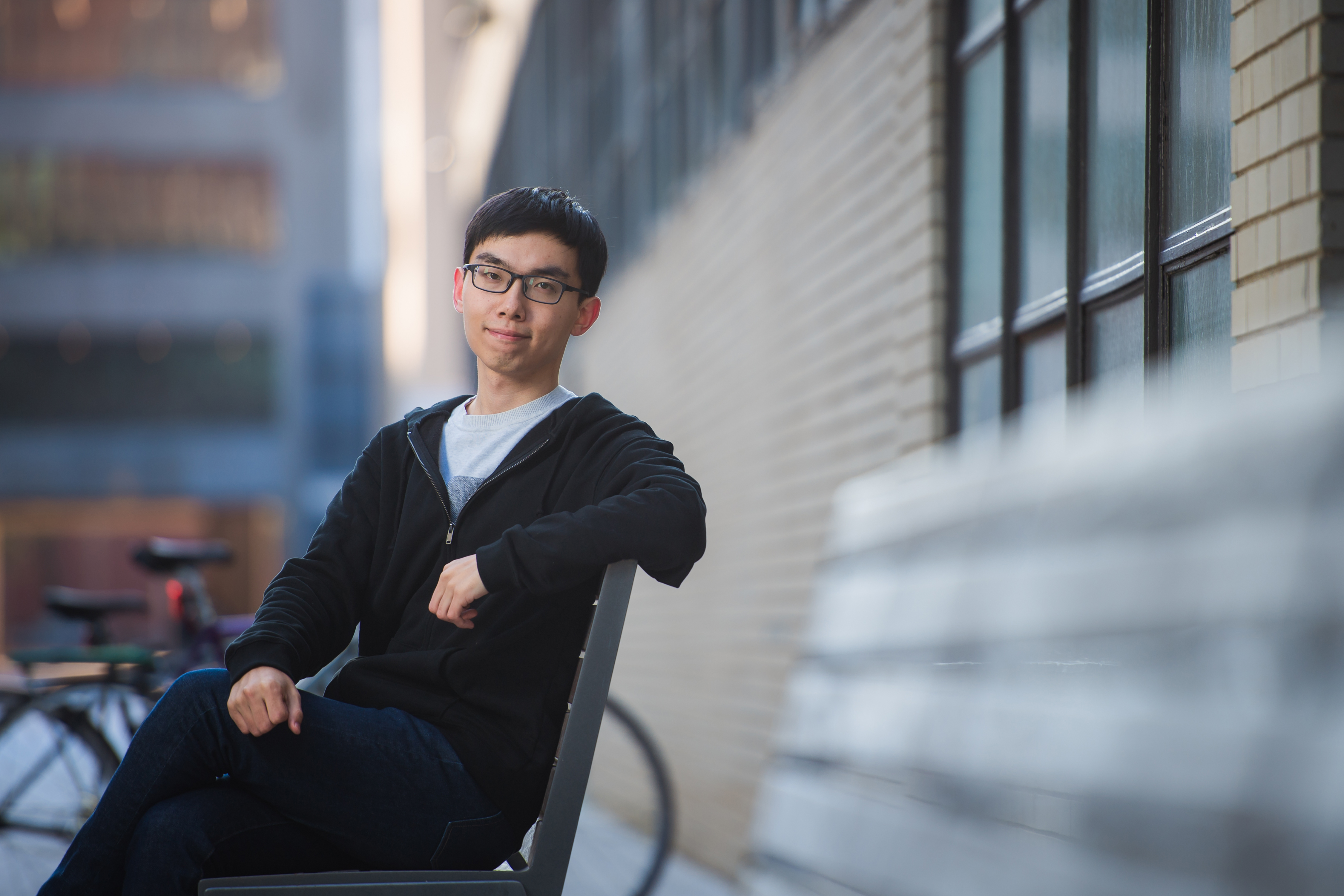
If we trace the origin of our love for nature, Lee Chang-go refers to the age of nine, looking at the night sky from his childhood home in Jinan, China. “At that moment, I felt that nature was so beautiful. I just wanted to go out of the earth and even go to the moon and Mars,” Lee recalls.
His childhood dream instilled his love of physics from middle school to high school and ultimately at Xi’an Jiaotong University in China.
Since then, Li’s passion for the sky has taken a microscopic form that is closer to the Earth. It was transformed into a love for quantum physics. Li is a fifth-year doctoral candidate at the Faculty of Nuclear Science and Engineering (NSE), working with Professor Paola Cappellaro on quantum information science, including quantum sensing and computation.
Quantum leap
The main paper that drives quantum information science is that changing the state of matter at the elementary particle level can have a significant impact on a much larger scale. Quantum computing, for example, relies on the finest changes in material properties to store and process more information than in simple classical binary modes.
The basic unit of information in quantum computing corresponds to a bit in a classical computer and is called a qubit. Taking advantage of defects in the material structure is one way to manufacture these qubits.
Aspects of Li’s research focus on very small diamond defects, some of which are on the nanometer scale. Experiments introduce atomic-scale defects called nitrogen-vacancy centers in these diamonds and use microwaves or lasers to expose the defects to very fine perturbations to create and control quantum states.
One of Li’s projects measures the fluorescence emitted by disturbed diamonds to provide detailed information about external stimuli. Just as you measure the temperature of an oven and measure that temperature, you can measure what and how much the oven perceives by measuring the fluorescence emitted by such defective diamonds. I can do it. For example, a sensor that can detect even hundreds of chains of the SARS-CoV-2 virus that causes Covid-19 is one of the applications Li is investigating with colleagues.
of Physical Review Letter, Li publishes findings from another research project to evaluate the symmetry of quantum systems. To study the properties of quantum systems, we need to understand how quantum states behave over time, and their symmetry is important. “Engineering a system with the desired symmetry is not an easy task,” says Li. “Quantum properties are very unstable because they can interact with the environment. Qubits require very good lifetimes. Here we develop methods to control and characterize such systems. The focus of yet another study, the results of which will be published shortly, is to simulate tensor gauge fields using diamond defects related to basic science.
Lee says that understanding quantum information is primarily about studying basic science. “The basic principles of this world are beautiful and can explain many interesting phenomena,” he points out. “This allows me to explore the universe and understand how nature works,” Li adds.
The man who travels far knows more
His passion for understanding how nature works, whether on a star scale or in small quantum units, has stimulated his interest in physics since he was a boy.
His parents encouraged his love of physics, and junior high school teachers thought him critically, found mistakes in textbooks, and taught him not to swallow information as truth. “To find out your truth, you need to do a simple experiment,” said Lee, a lesson learned from junior high school.
As the lesson was safely hidden, Lee found high school a little more challenging, and was initially placed in the middle of nearly 1,000 students. But hard work and learning from others led him to the top.
Lee, who was at the top of his class in both middle school and high school, pursued physics at Xi’an Jiaotong University, about 600 miles west of Beijing. He was the first to leave home and realized that he needed to boost school education on topics such as linear algebra. Again, the hard work paid off and Li graduated from the top of the class.
The college gave Lee the ability to study in the United States for some of his sophomores and college sophomores. Through the exchange program, Lee conducted a two-month summer study at the University of Notre Dame in 2015 and attended the University of California, Berkeley in 2016 as a third year student. Travel reinforces one of Lee’s favorite quotes: “People who travel far know more.”
Notre Dame was Lee’s first overseas trip. I remember trying to get used to burgers and french fries. This sets it apart from the traditional Chinese food he loves.
It was his study at UC Berkeley that solidified his love for quantum physics — he lovingly remembers the university library and cafeteria. By the time he returned to China, he wanted to go to graduate school and pursue research in this area. MIT’s NSE was invited as an opportunity to “work with the best people in the world,” says Li. Cappellaro is his inspiration. “She taught me how to think about research. I am very grateful,” he says.
In his spare time, Li relearns Chinese food (parents can help with hints) and plays mobile games such as “Arena of Valor” with friends. It was his pandemic hobby that he learned to play the guitar.
He continues to inspire Lee by learning his basic love for nature and how things work. “I’m focusing on the smallest, and there’s something really great there. It’s also about nature, right? When you learn how this little one works, how the big one works. You can also learn to do it, “says Li.
..