
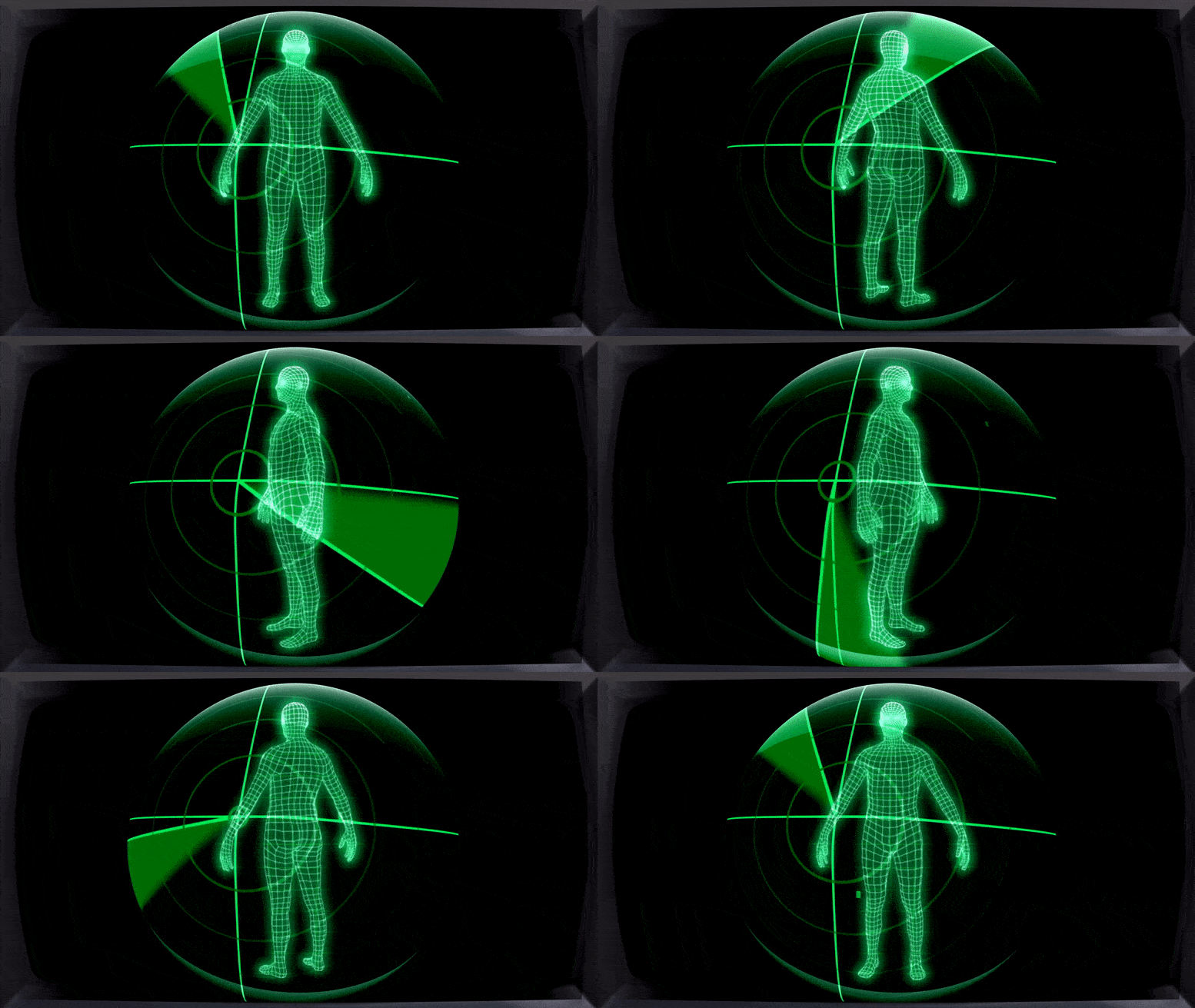
Terahertz technology has the potential to enable advanced scanners for security, medicine, and materials science. It also has the potential to enable much faster wireless communication devices than are currently possible.
Scientists have discovered new effects in 2D conductive systems that promise to improve the performance of terahertz detectors.
Recent physics discoveries in 2D conductive systems enable a new type of terahertz detector. The terahertz frequency between microwave and infrared on the spectrum of electromagnetic radiation has the potential to enable faster, safer, more effective imaging techniques and much faster wireless communications. The lack of effective real-world devices has hampered these developments, but this new breakthrough takes us one step closer to these advanced technologies.
A new physical effect when the two-dimensional electronic system is exposed to terahertz waves was discovered by a team of scientists at the Cavendish Institute, along with colleagues from the University of Augsburg (Germany) and the University of Lancaster.
“The fact that such effects can exist in highly conductive two-dimensional electron gases at much lower frequencies was not previously understood, but this can be proved experimentally. I did. “— — Wladislaw Michailow
First of all, what is a terahertz wave? “We communicate using mobile phones that transmit microwave radiation and use infrared cameras for night vision. Terrahertz is a type of electromagnetic radiation that lies somewhere between microwave and infrared radiation.” David Ritchie, Head of the Semiconductor Physics Group at the Cavendish Institute at the University of Cambridge, explains. This type of radiation source and detector is cheap, efficient and easy to use. This has hampered the spread of terahertz technology. “
Researchers in the Semiconductor Physics Group, along with researchers in Pisa and Turin, Italy, first demonstrated the operation of terahertz-frequency lasers and quantum cascade lasers in 2002. Since then, the group has continued to study terahertz physics and techniques, and is currently investigating and developing functional terahertz devices that incorporate metamaterials to form modulators and new types of detectors.

Wladislaw Michailow and post-manufacturing terahertz detectors showing devices in a clean room. Credit: Wladislaw Michailow
If the shortage of available devices is resolved, terahertz radiation may have many useful applications in security, materials science, communications, and medicine. For example, terahertz waves allow imaging of cancerous tissue that was not visible to the naked eye. They can be used in a new generation of safe and fast airport scanners that will enable us to distinguish drugs from illegal drugs and explosives, and can be used to enable even faster wireless communications beyond the cutting edge. ..
So what are your recent discoveries? “We were developing a new type of terahertz detector,” says Dr. Wladislaw Michailow, a Junior Research Fellow at Trinity College Cambridge. “But when we measured its performance, we found that it showed a much stronger signal than theoretically expected. So we came up with a new explanation.”
As scientists say, this explanation is about how light interacts with matter. At high frequencies, matter absorbs light in the form of a single particle, a photon. This interpretation, first proposed by Einstein, was able to form the basis of quantum mechanics and explain the photoelectric effect. This quantum photoexcitation is a method of detecting light with a smartphone camera. It also produces electricity from the light of solar cells.
The well-known photoelectric effect consists of the emission of electrons from a conductive material (metal or semiconductor) by incident photons. In three dimensions, electrons are either emitted into a vacuum by UV or X-ray range photons, or emitted from mid-infrared light into a visible range dielectric. The novelty lies in the discovery of quantum photoexcitation processes in the terahertz range, as well as the photoelectric effect. “The fact that such effects can exist in highly conductive two-dimensional electron gases at very low frequencies has not been previously understood,” explains Wladislaw, the lead author of the study. To do. The quantitative theory of effect was developed by colleagues at the University of Augsburg, Germany, and an international team of researchers recently published their findings in a reputable journal. Science Advances..
Researchers have responded to this phenomenon by calling it the “in-plane photoelectric effect.” In a corresponding paper, scientists explain some of the benefits of using this effect for terahertz detection. In particular, the magnitude of the optical response produced by the incident terahertz radiation due to the “in-plane photoelectric effect” is much greater than would be expected from other mechanisms previously known to cause terahertz optical responses. Therefore, scientists hope that this effect will enable the production of substantially more sensitive terahertz detectors.
“This is one step closer to making terahertz technology available in the real world,” concludes Professor Ritchie.
Reference: “In-plane photoelectric effect in a two-dimensional electronic system for terahertz detection” Wladislaw Michailow, Peter Spencer, Nikita W. Almond, Stephen J. Kindness, Robert Wallis, Thomas A. Mitchell, Riccardo Degl’Innocenti, Sergey A. Mikhailov, Harvey E. Beere, David A. Ritchie, April 15, 2022, Science Advances..
DOI: 10.1126 / sciadv.abi8398
This work is supported by the EPSRC project HyperTerahertz (number EP / P021859 / 1) and does not have a permit number. EP / S019383 / 1, Schiff Foundation, University of Cambridge, Trinity College Cambridge, and European Union Hollywood 2020 Research and Innovation Program Graphene Core 3 (Grant No. 881603).